
Household Goods Descriptive Inventory – Mover Docx
Claims Prevention & Tracking

Household Goods Descriptive Inventory

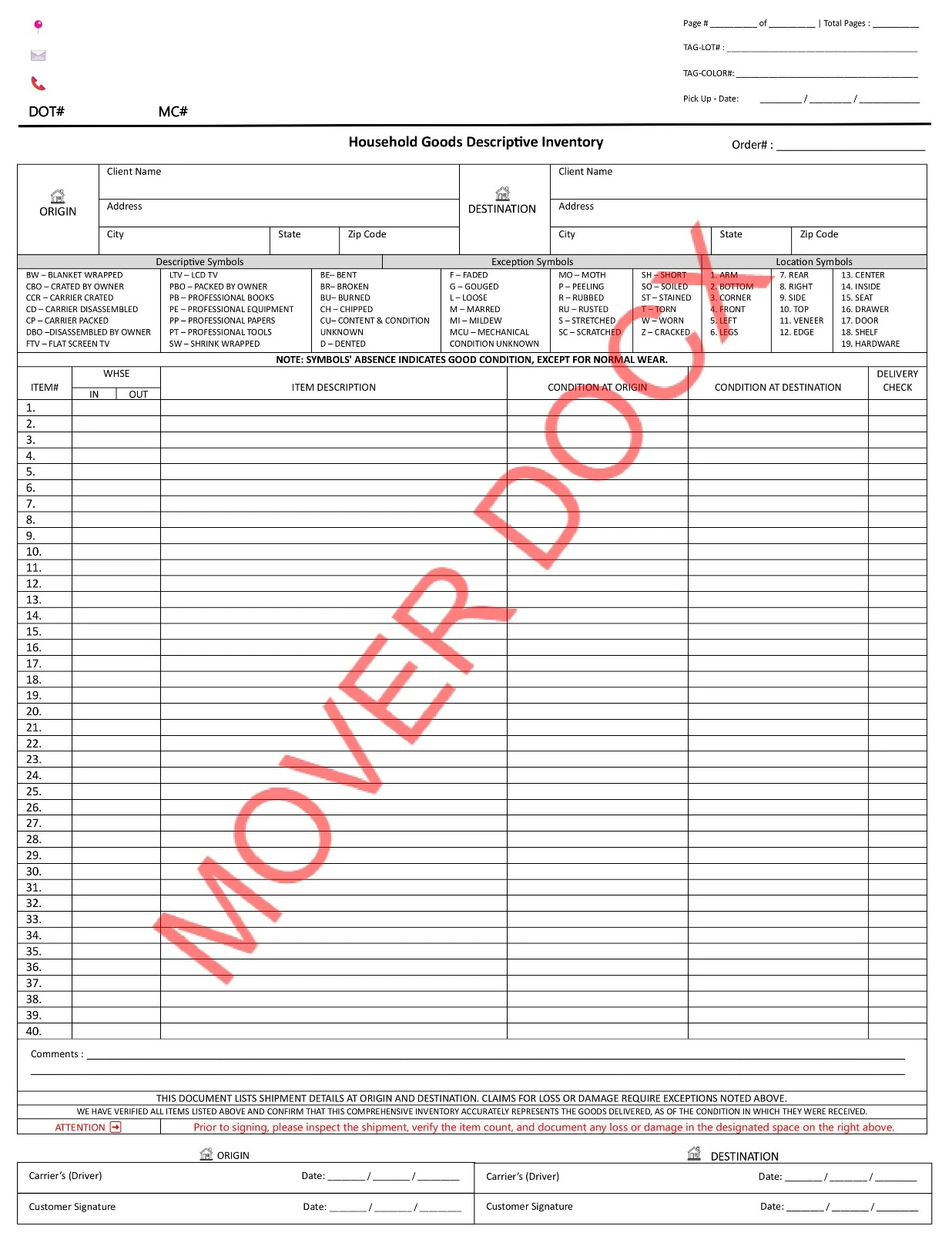
The essential, detailed **inventory form** for moving companies. Use this document to list every item, its **condition at origin**, exceptions, and shipper signatures to protect against false claims.

Sample of a Household Goods Descriptive Inventory Sheet

Clear Itemization & Tracking

Provides a numbered, detailed record of every item loaded, ensuring nothing is lost or unaccounted for.

Standardized Condition Codes

Includes pre-printed codes for common conditions (Good, Scratched, Dented) for fast and legally defensible documentation.

Dual Shipper Sign-Off

Requires customer and driver signatures at **both** origin and destination to validate item count and condition.

Your First Line of Claims Defense

See why this Descriptive Inventory is essential for claims prevention and accurate move management.

“This descriptive inventory is non-negotiable for our claims process. The pre-printed condition codes make it fast for crews to use while being legally defensible. Saves us countless arguments.”

Alex K.

Claims Manager, Pro-Move Logistics

“Our crews love the clean layout and the built-in system for marking exceptions. It eliminates disputes over existing damage—if it’s not on the inventory, the claim is much easier to manage.”

Maria L.

Operations Director, Elite Relocation

“The final sign-off for delivery condition is critical. This document ensures the customer acknowledges receiving everything in the condition listed. A fantastic resource.”

Sam R.

Local Moving Owner

“Switched from a generic inventory to this descriptive one and saw a 40% drop in damage claims filed. When the damage is documented beforehand, people don’t file.”

Tom H.

Coastline Movers

“Perfect layout for our tablets. We use this electronically for e-signing. The clarity of the item list and condition codes makes the process look professional and reliable.”

Jason W.

Cross-Country Van Lines

“The descriptive inventory is where you win or lose a claims case. This template is detailed enough to be strong but simple enough that my crew doesn’t skip fields. Ideal.”

Ben C.

Four Seasons Moving

“Every professional mover needs a solid inventory. This one is customizable and clearly designed by people who understand the legal requirements of an interstate move.”

Laura M.

Capitol City Moving

“Great for both full-service packing and customer-packed boxes. The system of codes makes it impossible to miss noting a large dent or scuff. Highly recommended for professionalism.”

Will J.

The Moving Specialists

“We use this inventory to walk the client through the condition of their high-value pieces before we load them. It manages expectations and avoids surprises at the delivery end.”

Susan P.

White Glove Movers

“A properly filled out Descriptive Inventory is the core of our business. This template is the best we’ve found for compliance and clarity. Great design.”

Gary T.

Tri-State Moving Co.

Share Your Experience

Help other movers by leaving a review of our inventory documents.

Descriptive Inventory – FAQ

Common questions about item tracking, condition codes, and claims defense.

It is a detailed list of every item or carton loaded onto the moving truck. It documents the **condition of each item at the time of pickup** using standardized condition codes and is signed by the customer and driver.
It is the single most important document for **claims prevention**. It legally establishes the condition of an item *before* it was moved, providing a strong defense against claims for pre-existing damage.
The **Bill of Lading** is the moving contract, covering charges and terms. The **Descriptive Inventory** is the itemized list, covering only the count and condition of the goods being moved.
**Condition codes** are standardized abbreviations (e.g., ‘G’ for Good, ‘D’ for dented, ‘S’ for scratched). They provide a fast, clear, and objective way for the crew to note the condition of an item.
The document must be signed by the mover’s **driver/foreman** and the **customer** at both the **origin (pickup)** and the **destination (delivery)** to confirm the item count and condition.